







No, Kevin Borjas did not claim the UFC flyweight championship under cover of darkness, no matter what the promotion’s website tells you.
The UFC debuted its new rankings on Monday, with META rankings (AI driven) up front and center, along with a tab to toggle media rankings on and off. And as anyone with an iota of experience in so-called “AI” (artificial yes, intelligent, no) could have predicted, there were issues out of the gate.
International visitors to the UFC’s official rankings page were greeted with the news that both Kevin Borjas (flyweight) and Navajo Stirling (light heavyweight) were champions. Depending on exactly what region you were visiting from, Charles Jourdain might have popped up as bantamweight champ as well.
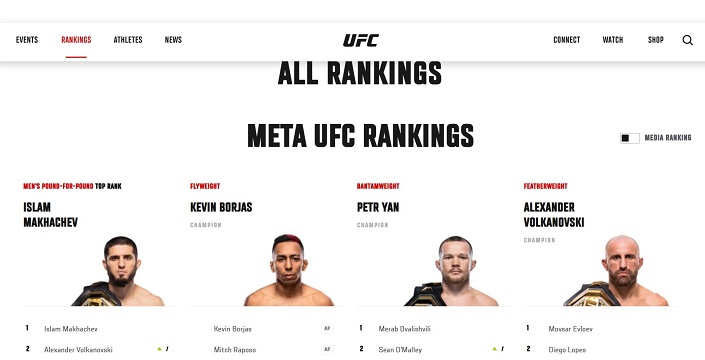
Given Stirling competed just this past weekend, winning his tenth fight as a pro against Ion Cutelaba, you can rest assured he didn’t fight for 205lb gold this morning. Whoever implemented the new rankings in the back end, however, apparently threw the switch without checking the result from different geolocations.
Even the U.S. wasn’t completely unhindered: while the list of champions (and presumably the rankings themselves) appeared more or less correct, at least some U.S. visitors to the rankings page were not served the pound-for-pound list. International viewers at least got that.
According to a press release issued on Monday introducing the new rankings system, “Meta UFC Rankings will be automatically calculated and updated by Monday following every official UFC event. To determine individual athlete ranks, the system combines statistical modeling and machine learning with the deep domain expertise of the UFC. It evaluates a comprehensive set of objective metrics, including outcome probability, win type, fighter trajectory, and weight-class sensitivities.”
“Not all wins or losses are treated equally: Under the Meta UFC Rankings, beating a higher-ranked opponent carries more weight than defeating a lower-ranked one, and a dominant finish against a Top 5 ranked contender is a stronger signal than a close decision over an unranked opponent. The system also accounts for recency, with more recent fights carrying greater weight while applying inactivity penalties for fighters who go extended periods without competing. By relying exclusively on measurable fight data, the Meta UFC Rankings ensure a fighter’s placement accurately reflects their true competitive performance inside the Octagon – nothing else.”
The new rankings appear to be in a transition phase, and Dana White did not appear to entirely rule out humans being involved in the rankings while speaking to the media following UFC Vegas 119.


